
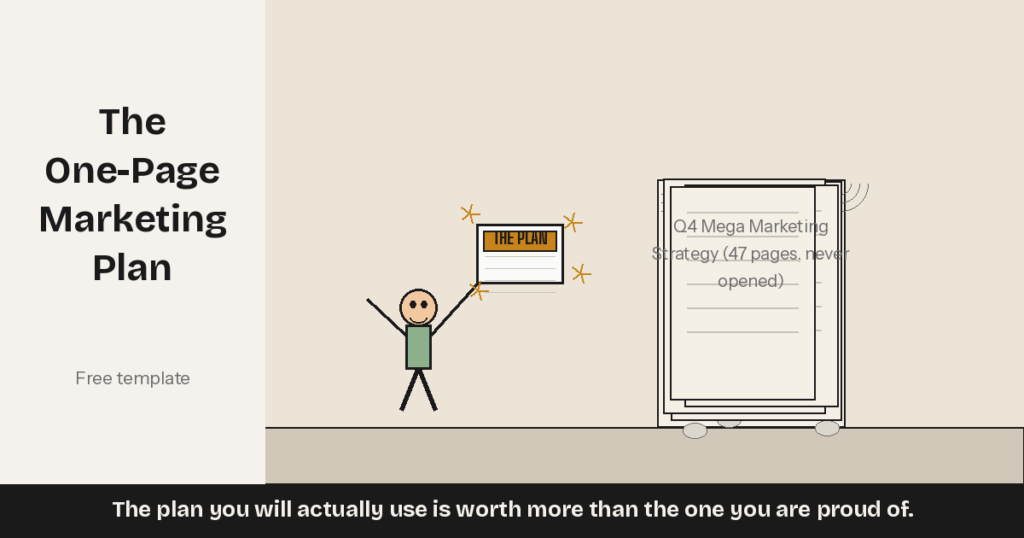
The average DIY marketing plan template asks you to fill in a competitive analysis framework before you have written a single word about what you are actually trying to do this month.
If you are a micro-business owner doing your marketing in the gaps between everything else, that is not useful. It is a reason to close the tab and do nothing.
This template is different. It fits on one page, it takes under 45 minutes to fill in, and it gives you a clear focus for the next month. That is genuinely all it tries to do.
Why even a simple plan makes a real difference
A plan is not about paperwork. It is about making a decision in advance so you do not have to make it again every week.
Without one, every Monday starts with the same question: what should I do for my marketing this week? That question burns time and energy that could go into actually doing it.
With a simple plan, the question is already answered. You know who you are talking to, what you are trying to achieve this month, which channel you are using, and what your one weekly task is. The decision has been made. You just have to show up and do it.
The plan does not need to be sophisticated. It needs to be specific enough that you can act on it without thinking too hard.
Why most templates do not work at micro-business scale
Standard marketing templates are built for teams, quarterly cycles, and multiple channels running in parallel. Asking a solo founder to fill in a channel attribution matrix is the same as handing someone a map of the whole country when they just need to know how to get to the next town.
The other problem is time horizon. Most templates are built for quarterly or annual planning. At micro-business scale, a plan that runs for three months can feel obsolete by month two if the business shifts shape. A monthly plan you actually use is worth more than a quarterly one that sits in a folder.
The template below is built on the Three Levers Framework: Time, Knowledge, and Budget. Each section asks you to make one clear decision based on what you actually have, not what a textbook says you should have.
How this DIY marketing plan template works
The plan has five sections. Five to ten minutes each.
Section 1: Your audience, in one sentence. Who is this month’s marketing for? One specific kind of person, with one specific problem or need. If you sell to several types of customer, pick the one you most want to reach this month.
Section 2: Your goal this month. One measurable outcome. Something you can look back on in four weeks and say clearly whether it happened or not. Five new email subscribers. Two new enquiries. One new stockist. One specific thing.
Section 3: Your one channel. Which single channel are you focusing on? Email, Instagram, LinkedIn, referrals, your Google Business Profile. Just one. If you are tempted to write two, pick the one your audience is more likely to actually see.
Section 4: Your weekly action. What is the one thing you will do each week on that channel? Keep it small enough to survive a busy week. One post, one email, one referral message. If it would get cancelled the moment something urgent came up, make it smaller.
Section 5: Your one metric. How will you know if it is working? One number, checked once a week. Open rate, enquiries received, profile visits. That is it.
Your micro business marketing checklist and one-page plan
Fill this in for the month ahead. Keep it somewhere you will actually see it.
My one-page marketing plan
Month: _______________
My audience this month Who am I talking to? (One sentence: describe the specific person, their situation, and what they need.)
My goal this month What does success look like at the end of the month? (One specific, measurable outcome.)
My channel Which single channel am I focusing on?
My weekly action What is the one thing I will do each week? (Small enough to survive a busy week.)
My metric How will I know if it is working? (One number, checked once a week.)
My lever check Which two levers am I working with this month?
[ ] Time and Knowledge [ ] Time and Budget [ ] Knowledge and Budget
A completed example
Here is what the plan looks like when filled in properly.
Month: April
My audience this month London-based women aged 35 to 50 who are looking for sustainable gifting options and have bought from me once before.
My goal this month Generate five repeat orders from existing customers by the end of the month.
My channel Email.
My weekly action Send one short email to my existing customer list each fortnight. Week one: product spotlight. Week three: behind-the-scenes note.
My metric Email open rate. Target: above 35 percent.
My lever check [x] Time and Knowledge
When the plan is not working
A plan is not a contract. If something is clearly not working by week three, change it.
Most of the time, the problem is not the goal. It is that the weekly action was too ambitious for real life. If you planned to send three emails and only sent one, the fix is not to try harder next month. It is to plan for one email and actually send it. Consistency at a smaller scale produces better results than ambition that collapses under pressure.
The second thing to check is whether the channel and the audience actually match. If you are targeting local customers through LinkedIn when most of them use Facebook, no amount of good content will fix that. A quick channel change, same goal, is often all it takes.
Fill this in honestly each month, review it at the end, and adjust one thing. Three months of doing that will tell you more about what works for your specific business than any generic guide, because the data is yours.
👉 Read: DIY marketing for micro-businesses, the full guide.
👉 Read: When DIY marketing stops working and what to do next.