
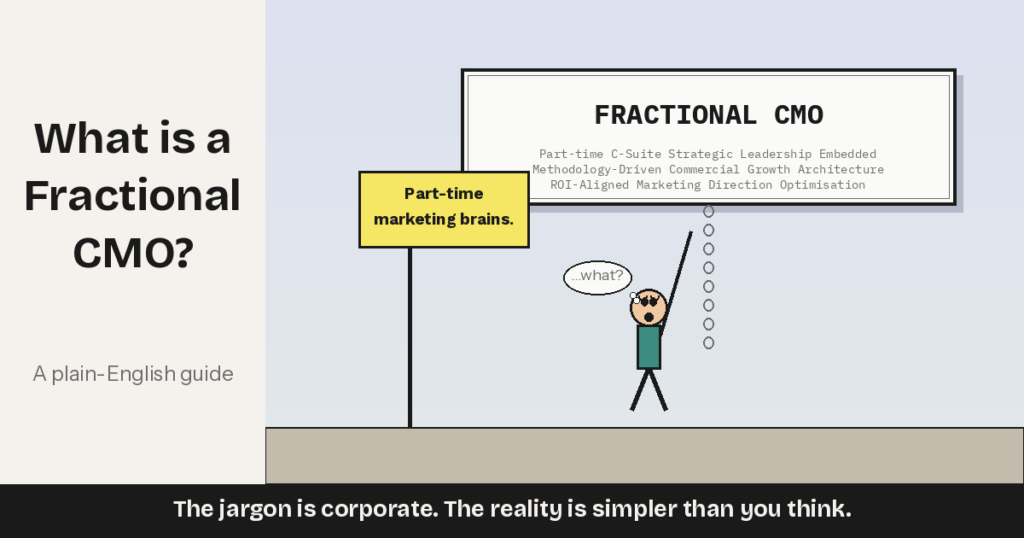
The term “fractional CMO” gets thrown around a lot in startup and SME circles. Most of the articles you will find about it are written for businesses with marketing teams to manage, agencies to brief, and funding rounds to prepare for.
If you run a micro-business with fewer than ten people and do most or all of your marketing yourself, you could be forgiven for assuming this is a conversation for someone else. It mostly sounds like something for founders who have already figured out the basics and are ready to scale. Expensive, senior, and probably not for you.
This guide is here to challenge that assumption. A fractional CMO is not only for larger businesses. For the right micro-business at the right moment, getting fractional CMO support for small businesses can be the thing that stops you going around in circles and starts moving your marketing in a direction that actually makes sense.
The quick answer
A fractional CMO is a senior marketing professional who works with your business part-time. Not an employee. Not a freelancer doing specific tasks. A strategic lead: someone who helps you understand what your marketing should be doing, and why, rather than just what to post next week.
The “fractional” part simply means they work with several businesses at once, dedicating a portion of their time to each. You get the thinking and the experience of someone who has run marketing at a senior level, without paying for a full-time salary.
A full-time CMO in the UK commands a salary of £100,000 or more before employer costs. Most micro-businesses could not justify that, and most would not need that level of resource either. The fractional model exists precisely because that gap between “no strategic help” and “full-time hire” is where most small businesses actually live.
Why fractional CMOs exist
Until relatively recently, your options as a small business owner were limited. Do your marketing yourself. Hire a freelancer. Bring in an agency. Or eventually hire someone. There was no real middle ground for strategic thinking that was also affordable.
The fractional model emerged as a practical response to that gap. What most small businesses need is not more execution. It is better direction. More posts, more emails, more ads, none of that helps if you do not know what you are trying to achieve or whether the channels you are using are the right ones.
At the same time, experienced senior marketers started offering their time on a portfolio basis, working with multiple clients rather than one employer. The economics work for both sides: you get senior input at a fraction of the cost of a full hire, and they build a varied practice rather than being dependent on a single business.
Demand for fractional marketing support in the UK has grown consistently since 2020. Economic uncertainty, hiring freezes, and the rising cost of agency retainers have all pushed more founders towards this model. It is no longer niche.
What a fractional CMO actually does
What a fractional CMO does for a micro-business looks quite different to what they do for a funded startup with a team of five marketers. The work is less about managing people and more about giving the founder a clearer picture of what is worth their time.
Strategy and direction
The core work is always strategic. A fractional CMO starts by understanding where your business is: what is working in your marketing, what is not, what you are trying to achieve, and what is getting in the way. From that, they help you make better decisions about where to focus.
That might mean helping you understand which channel is actually producing customers rather than which one feels busiest. It might mean simplifying your marketing so you stop doing things that are not moving anything. Or it might mean identifying a positioning angle your competitors are not taking and building messaging around it.
Making the most of what you already have
For a micro-business, a fractional CMO is rarely there to add more activity. They are there to make what you are already doing work harder.
That means looking at what you have: your existing content, your email list, your Google Business Profile, your social presence, your referral network. And then asking which of those is being underused, which needs to be improved, and which should be dropped entirely.
Ella, a sustainable baby clothing founder, did not need more marketing. She needed her existing marketing pointed in the right direction. Three months after bringing in a fractional CMO for just eight hours a month, her conversion rate was up 40 percent. Not because she was doing more, but because she was doing the right things. You can read her full story here: How a fractional CMO can help your micro-business.
What they do not do
At micro-business scale, a fractional CMO will not usually handle your execution. They are not there to write your emails, post on your social media, or run your ads day to day. That is the role of a freelancer or an in-house hire.
What they do is tell you what your emails should be about, which social channel is worth your time, and whether running ads makes sense at your current stage. The thinking, not the doing. If you have no one to handle the execution, that is worth being honest about before you bring someone in. Some will take on a more hands-on role at the lighter end of the market, but strategic clarity is always the primary value.
Is a fractional CMO right for your micro-business?
Not always. There are stages of a micro-business where this makes sense, and stages where it does not.
The situations where it tends to work well have a few things in common. You have been doing your own marketing for a while and feel like you are going around in circles. You are getting some results but cannot identify what is driving them. You know you need help but are not ready for a full-time hire. And you have at least a modest budget to invest in getting unstuck.
The situations where it is less likely to be the right investment: you are still working out whether your product or service has a market, you have no time to implement the advice you would receive, or your budget is genuinely zero with no room to change.
If you are not sure which applies to you, the Three Levers Framework is a useful starting point. If you have time and some knowledge but are running low on budget, a few hours of external strategic input might be exactly what bridges the gap. If you are short on all three, you are probably not yet in a position to make the most of what a fractional CMO offers.
Explore the Three Levers Framework here.
How a fractional CMO differs from a freelancer or an agency
These three options get conflated often, but they solve different problems.
A freelancer executes specific tasks. They write your blog posts, manage your social accounts, design your emails, or run your paid ads. They are excellent at doing. They are generally not there to tell you what to do or why.
A marketing agency executes at scale. They bring a team and a range of capabilities, usually on a monthly retainer. Like freelancers, they work best when they have clear direction. Without it, agencies tend to default to activity metrics: more posts, more impressions, more output, whether or not it is moving the right things.
A fractional CMO provides the strategic layer that makes both of those more effective. They are not competing with freelancers or agencies. They are the person who tells them what to do and holds them accountable for outcomes rather than outputs.
For a micro-business, the practical decision is usually simpler than it sounds. Do you need someone to do things, or do you need someone to tell you what things to do? If it is the former, a freelancer is probably the right place to start. If it is the latter, a fractional CMO is more likely to be the answer.
Read the full comparison: Fractional CMO vs Freelance Marketer vs DIY.
What does a fractional CMO cost?
Most pricing guides for fractional CMO services quote day rates of £800 to £1,500 and monthly retainers of £2,000 to £10,000. Those figures reflect the traditional market, aimed at businesses with revenue north of £1 million and teams to manage. They are not wrong, but they are not the full picture.
At micro-business scale, the engagement looks different and the cost reflects that. Advisory models, shorter retainers, and fixed-scope projects exist specifically for businesses that need senior thinking without a four-day-per-month commitment.
A realistic starting point might be a one-off strategy audit or sprint, a light ongoing retainer of a few hours per month, or a coaching model where you work through decisions regularly with someone who has seen them before. The accessible end of the market starts considerably below the figures you will typically see quoted.
Read the full cost breakdown: How Much Does a Fractional CMO Cost for a Micro-Business?
How to know if you are ready
Ready does not mean having everything sorted. It means being in a position to make use of what a fractional CMO offers.
A few useful questions: Do you have a clear enough sense of what you are selling and who you are selling it to? Have you been marketing consistently enough to have some data or experience to build on? Do you have even a few hours a week to implement the direction you receive? Is there a specific plateau or problem you are trying to break through?
Most people who answer yes to most of those are ready, even if they do not feel like it. The engagements that tend to produce the least value are the ones where the business has not yet done enough marketing to know what is working, or where the founder has no capacity to act on what they learn.
The best moment is usually the one where doing more of the same thing clearly is not going to move you forward. That is when external strategic thinking pays for itself quickly.
Read: When DIY Marketing Stops Working and What to Do Next.
Where to go next
If you want to understand what fractional CMO support costs at micro-business scale, the pricing guide breaks it down honestly. How Much Does a Fractional CMO Cost for a Micro-Business?
If you are weighing up fractional CMO support against hiring a freelancer or carrying on with DIY, the comparison article maps out all three options clearly. Fractional CMO vs Freelance Marketer vs DIY.
If you are already close to a decision and want to know how to make the engagement work, start here. How to Get the Most from a Fractional CMO When You Run a Micro-Business.
And if you want to revisit the DIY foundations before making any decisions about external help, the full guide is here. DIY Marketing for Micro-Businesses: A Practical Guide.