
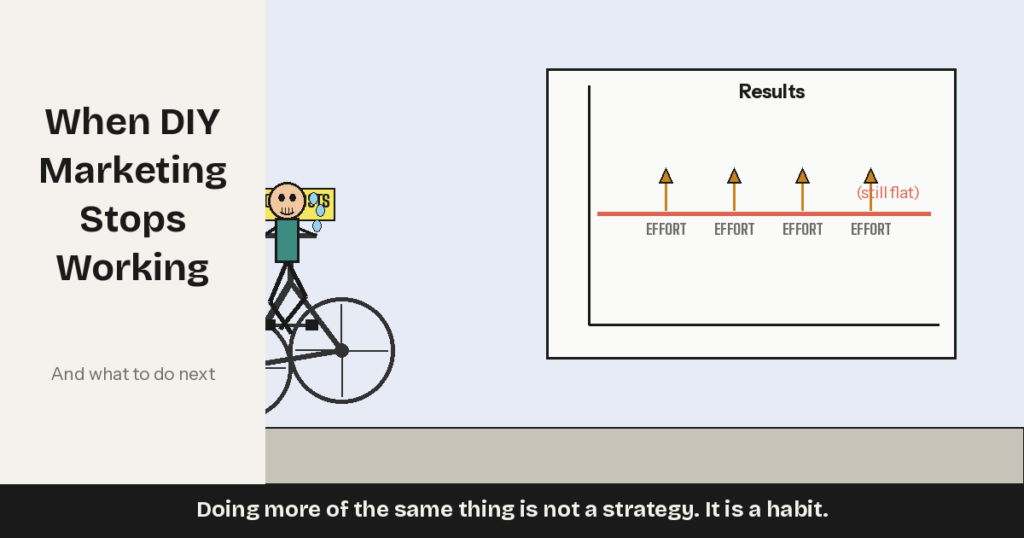
Most micro-business owners start doing their own marketing because they have no other choice. There is no budget for an agency, no time to hire properly, and plenty of advice online telling you that you can absolutely do this yourself.
And for a while, you can.
Then something shifts. Six months in, maybe twelve. You are a time-poor business owner doing your best: still posting, still emailing, still showing up. But the effort and the results have quietly stopped moving at the same speed. The gap between the two is where most people start to wonder if something is wrong with them, their business, or their approach.
Usually it is none of those things. But it is worth understanding what is actually happening.
Five signs your DIY marketing has hit its ceiling
None of these on their own mean you need to make a change. But if two or three of them sound familiar, it is worth paying attention.
You are consistent, but nothing is growing. You have built a routine. You post, you email, you show up. But the numbers have plateaued. New followers, new subscribers, new enquiries, all of them have flatlined at roughly the same level they were six months ago.
You are not sure what is actually working. You are doing several things, but you could not confidently say which one is bringing in customers. When someone new gets in touch, you genuinely do not know how they found you.
Marketing feels like a chore rather than a choice. You are doing it because you feel you should, not because you have a clear sense that it is moving anything forward. That reluctance tends to show up in the quality of what you produce.
You have run out of ideas. The well is dry. You are recycling old posts, sending emails that feel thin, and struggling to think of anything worth saying. This is not a creativity problem. It is usually a strategy problem.
You know what you should be doing, but you cannot find the time. The ideas are there. The execution is not. Every week you mean to write the article, record the video, set up the email sequence. Every week something more urgent wins.
Why this is not your fault
DIY marketing has a natural ceiling for every business. It is not a flaw in you or your approach. It is a structural limit.
When you are doing everything yourself, your marketing can only ever be as good as the time and energy you have left over after running the actual business. And as the business grows, that leftover time shrinks.
This is why consistent, competent DIY marketing tends to stop working not when you get worse at it, but when the business gets bigger. The marketing that carried you through the first six months cannot always carry you to month eighteen. Recognising that is not a reason to feel stuck. It is a reason to make a different decision.
What to do when DIY marketing is not enough
You do not have to choose between doing everything yourself and handing it all over to an agency. There is a lot of useful territory in between.
Option 1: Audit what you are already doing before changing anything
Before assuming you need external help, it is worth asking whether the problem is strategy rather than capacity.
Sometimes the issue is not that you are running out of time. It is that the time you are spending is going into the wrong things. A single honest look at what you are doing and what each activity is actually producing can change what the next six months look like.
Ask yourself this: if you had to cut your marketing activity in half tomorrow, what would you keep? The answer is usually more useful than any new tactic, and it tells you where to focus before spending money on anything else.
Option 2: Bring in part-time strategic support
This is the middle ground most micro-business owners do not know exists.
A fractional CMO is a senior marketing professional who works with you for a few hours a month, rather than full-time. They are not there to do the execution. They are there to give you a clear strategy, identify what to focus on, and stop you spending time on activity that is not moving anything forward.
The cost is far less than a full-time hire. Most fractional CMOs working with micro-businesses charge between £500 and £1,500 a month, which is often less than a single month of undirected ad spend. One founder we wrote about cut her ad budget, shifted platforms, and saw her conversion rate increase by 40 percent within three months, not because she worked harder, but because the strategy changed.
For a business with good DIY instincts but no clear direction, a few hours of senior input can redirect months of effort.
Read more: how a fractional CMO can help your micro-business.
Option 3: Outsource one specific bottleneck
You do not have to outsource your marketing. You can outsource one part of it. The part that takes the most time and produces the least result. The part you consistently avoid because you are not good at it, or because it sits at the bottom of every to-do list you write.
For some businesses, that is copywriting. For others, it is ad management, design, or SEO. A freelancer working on one specific task for a few hours a month costs far less than an agency retainer, and frees up the time and headspace you need to do the rest of your marketing properly. Sometimes removing one persistent bottleneck is enough to get everything moving again.
How to work out which option fits your situation
The right option depends on which lever you are short on.
If time is the problem, option 3 tends to help most. Getting specific tasks off your plate buys back the hours you need to think and plan.
If knowledge or strategy is the problem, option 2 is more likely to move things. Spending more time on the wrong activity is not the answer. Better direction is.
If you are not sure which it is, start with option 1. A proper look at what you are doing and what it is producing will usually tell you.
A five-minute self-assessment
Work through these questions honestly before making any decisions.
- In the last three months, have you gained any new customers through your marketing? If yes, do you know which channel brought them?
- Have your key metrics, email open rate, social reach, enquiries, moved in the last six months, or stayed roughly the same?
- Could you describe your current marketing strategy in two or three sentences? Not what you do, but why you do it and what it is building towards?
- If you stopped all your marketing activity tomorrow, how long before you noticed it in your revenue?
- Is there one part of your marketing you consistently avoid or delay? What is stopping you?
There are no right answers. But if you are vague on most of these, the problem is likely strategy rather than effort. And strategy is fixable without necessarily spending more time.
What to do this week
Pick one of the questions from the self-assessment and sit with it for a few days. The answer will usually point you somewhere useful.
If it points towards needing clearer strategy, the fractional CMO article covers what that kind of support actually looks like in practice, what it costs, and whether it makes sense for a business at your stage.
If it points towards specific gaps in what you are doing, the DIY marketing guide covers the foundations worth revisiting before you change anything else.